Caffeine and Sleep: The Science of When to Avoid It
• By CaffCalc Team
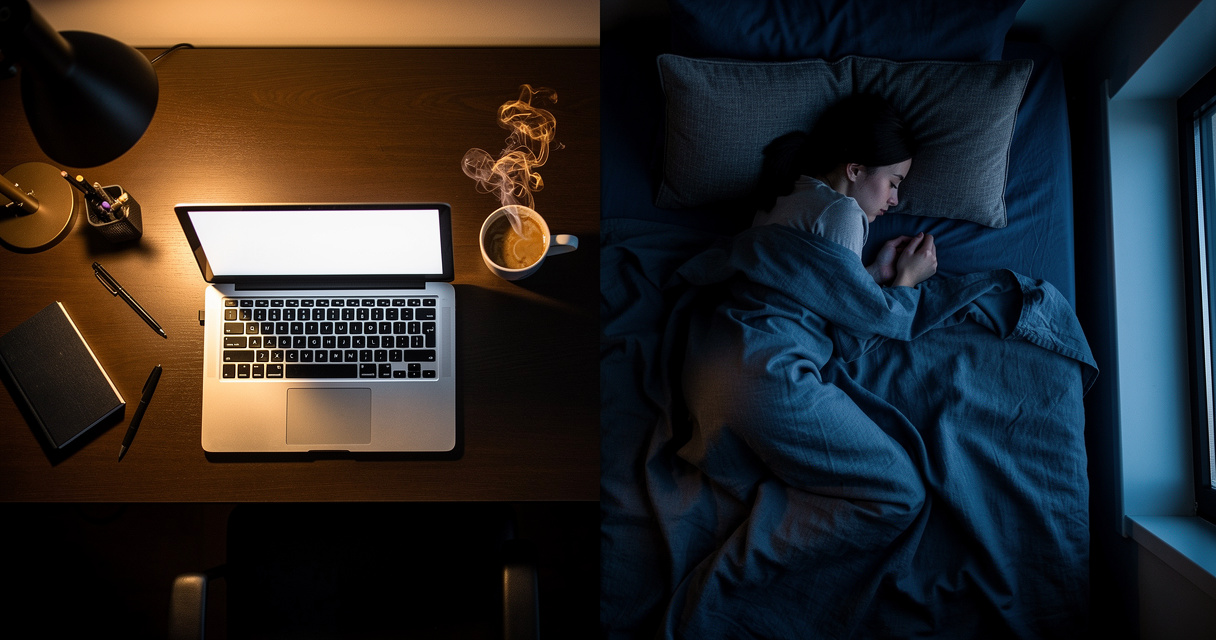
Caffeine and Sleep: The Science of When to Avoid It
Your 3 PM coffee is quietly sabotaging tonight’s sleep.
It feels harmless in the moment—just a little afternoon pick-me-up. But caffeine has a sneaky half-life that keeps it active in your brain for hours longer than you’d expect. Research now shows that a single cup of coffee consumed 6 hours before bed can still slash an hour off your total sleep time.
In this guide, we’ll translate the latest research on caffeine’s half-life, adenosine signaling, and sleep architecture into practical cutoff times you can actually use. You’ll learn exactly when to stop drinking caffeine based on your bedtime, why dose matters more than most people realize, and what to do if you’re especially sensitive.
Why Caffeine Timing Matters for Sleep
Caffeine keeps you alert by blocking adenosine, a sleep-promoting chemical that accumulates in your brain throughout the day. By occupying adenosine receptors—especially the A2A subtype in key arousal circuits—caffeine prevents the natural drowsiness signal from getting through.
The result? When you drink caffeine too late, it can delay sleep onset, shorten total sleep time, and strip away restorative deep sleep. A 2010 review in Sleep Medicine Reviews confirmed that caffeine’s alerting effect stems primarily from this adenosine blockade, not from calories or a sugar rush.
Three factors determine how much caffeine disrupts your night:
- Timing and dose together drive the effect—later and larger hits are worse. A landmark 2013 study in the Journal of Clinical Sleep Medicine demonstrated this clearly.
- Your personal metabolism varies widely based on genetics, smoking status, hormones, pregnancy, and medications. A 2009 population pharmacokinetics study showed half-life can range from under 3 hours to well over 7.
- Tolerance doesn’t fully protect you. Even regular drinkers lose deep sleep to late caffeine, sometimes without realizing it.
The Science: Half-Life, Dose, and Sleep Stages
Caffeine is absorbed quickly, peaking in your bloodstream within 30–60 minutes. Its average half-life in healthy adults is roughly 3–7 hours, meaning a significant portion can still be active at bedtime if you drink it in the afternoon.
Half-life shifts based on your biology. Smokers tend to clear caffeine faster. Pregnancy can extend the half-life to around 10 hours in the third trimester, and certain oral contraceptives can push it to roughly 11 hours.
What caffeine does to your night
Controlled trials and meta-analyses paint a consistent picture. Caffeine taken too close to bedtime:
- Increases sleep latency (time to fall asleep)
- Reduces total sleep time and overall sleep efficiency
- Decreases deep slow-wave sleep (N3), the stage responsible for physical restoration
- Has mixed effects on REM, though habitual use may delay REM onset
A 2023 systematic review and meta-analysis in Sleep Medicine Reviews quantified these effects across dozens of studies.
Timing matters more than you think
The classic Drake et al. (2013) study found that 400 mg of caffeine taken 0, 3, or even 6 hours before bed still disrupted sleep significantly. More recent meta-analytic work suggests that for a typical coffee (~100–110 mg), you need about 9 hours of buffer to avoid a measurable reduction in total sleep time. Higher doses may require even longer.
Dose creates a steep curve
A 2025 randomized crossover trial published in Sleep reported that 400 mg consumed within 12 hours of bedtime altered sleep architecture and increased fragmentation. Meanwhile, 100 mg up to 4 hours before bed produced no significant objective change in that small sample. The takeaway: the dose-response relationship is steep, and individual variability is real.
Quick definitions
- Half-life: The time for your body to eliminate half the caffeine. After one half-life, 50% remains; after two, 25%; after three, roughly 12.5%.
- Sleep architecture: The pattern of sleep stages across the night—light sleep (N1/N2), deep sleep (N3), and REM. Deep sleep supports physical restoration; REM supports memory and mood.
Practical Cutoffs: When to Stop Caffeine Based on Your Bedtime
Use these evidence-informed buffers as starting points. Adjust earlier if you’re sensitive, pregnant, or sleeping poorly.
Small coffee or tea (~80–120 mg): Stop at least 8–10 hours before your target bedtime.
- Example: Bedtime 10:30 PM → last cup by 12:30–2:30 PM.
- This aligns with meta-analytic estimates (~8.8 hours for ~107 mg).
Higher doses—energy shots, strong brews, pre-workouts (~200–300 mg): Stop 12–14 hours before bed.
- Example: Bedtime 10:30 PM → last high-dose caffeine by 8:30–10:30 AM.
- The 2023 meta-analysis estimated ~13.2 hours for ~217 mg; the 2025 trial found 400 mg within 12 hours still altered sleep.
Pregnant or using estrogen-containing oral contraceptives: Consider an even earlier cutoff and a lower daily limit. Pharmacokinetic studies show half-life can extend to ~10 hours (late pregnancy) and ~11 hours with some oral contraceptives. Many authorities advise keeping total daily caffeine ≤200 mg during pregnancy.
If you smoke: You may metabolize caffeine faster, but late-day caffeine can still disrupt sleep. Don’t use smoking status as a free pass for evening espresso.
If you have insomnia or fragmented sleep: Adopt a hard cutoff at local noon for two weeks and reassess. The CDC specifically recommends avoiding caffeine in the afternoon and evening for better sleep quality.
Pro tip: Many “medium” coffees hold 2–3 small cups’ worth of caffeine. Use CaffCalc to total your daily caffeine intake from coffee, tea, energy drinks, sodas, and chocolate—then decide where to trim.
Putting It into Practice: 7 Actionable Strategies
1. Set a personal caffeine curfew
Pick a cutoff that matches your bedtime: 9 hours for ~100 mg, 12–14 hours for ≥200 mg. Set a recurring calendar reminder on your phone.
Why it works: It respects the half-life math and the dose-timing relationship shown in meta-analyses.
2. Front-load your caffeine
Have your strongest dose in the morning when alerting benefits are highest and sleep risk is lowest. If you need an afternoon lift, opt for a smaller dose—half-caf tea at ~40–60 mg—and keep the time buffer intact.
3. Mind the hidden sources
Colas, energy drinks, pre-workouts, pain relievers (some contain 65 mg per tablet), and even dark chocolate all contribute to your total. The FDA cites ~400 mg/day as an amount not generally associated with negative effects for most healthy adults—but you need to know your actual total to stay within it.
4. Match dose to task, not to habit
Use the least amount that gets the job done. Try 50–100 mg for a focus bump; save 150–200 mg for genuinely high-demand windows. Higher single doses (≥300–400 mg) are most likely to dent your night.
5. Try a caffeine nap—but only before mid-afternoon
Drink 100 mg of caffeine, then immediately take a 15–20 minute nap. You wake up just as the caffeine kicks in, getting a double restoration boost. The CDC’s NIOSH training materials describe this strategy for shift workers—but only use it before 2 PM to protect nighttime sleep.
6. Respect sensitive life stages
During pregnancy, keep total intake ≤200 mg/day and move your cutoff earlier. In late pregnancy, consider switching to decaf entirely. The American College of Obstetricians and Gynecologists (ACOG) recommends this threshold. Always talk with your clinician about medications that interact with caffeine metabolism.
7. Build non-caffeine energy habits
Daylight exposure within 30 minutes of waking, 10-minute movement breaks, proper hydration, and a consistent sleep schedule all reduce dependence on late-day caffeine. These aren’t just nice ideas—the CDC’s sleep guidance specifically recommends them as alternatives to afternoon stimulants.
How Caffeine Changes Sleep Architecture (in Plain English)
Even if you fall asleep on time, caffeine can hollow out your sleep quality from the inside.
Less deep sleep. Caffeine reduces slow-wave sleep—the “body repair” stage where tissue growth, immune function, and energy restoration happen. You may clock 7 hours in bed but wake up feeling like you got 5. The 2023 meta-analysis confirmed this effect across multiple studies, especially at higher doses or later intakes.
Delayed REM with regular use. A 2021 study in the Journal of Biological Rhythms found that habitual daytime caffeine delayed REM sleep promotion and worsened perceived sleep quality—even when the last dose wasn’t particularly close to bedtime. Your dream sleep gets pushed later into the night, where it’s more easily cut short by your alarm.
More awakenings. Wake-after-sleep-onset time tends to increase with caffeine, fragmenting the night into shorter, less restorative chunks. You might not remember waking up, but your body does.
Personalized Factors That Shift Your Cutoff
Not everyone metabolizes caffeine the same way. Here’s what might move your personal curfew earlier or later.
Faster metabolism (smokers): Smoking induces CYP1A2, the liver enzyme that breaks down caffeine, shortening half-life. But faster clearance doesn’t mean evening caffeine is safe—even reduced levels can lighten sleep.
Slower metabolism (pregnancy, oral contraceptives): Half-life can extend toward 10–11 hours in these situations. If you’re in this group, a morning-only caffeine policy may be the safest approach.
Genetic sensitivity: Variants in the ADORA2A and CYP1A2 genes influence both how caffeine makes you feel and how quickly you clear it. If you notice jitters, racing thoughts, or sleep trouble, reduce both dose and frequency, and move all caffeine earlier. For a deeper look at how caffeine interacts with your body, see our caffeine science page.
Frequently Asked Questions
Q: What’s the safest daily caffeine limit for healthy adults?
Most U.S. authorities, including the FDA, cite up to 400 mg/day as not generally associated with negative effects for healthy, nonpregnant adults. However, sensitive individuals—especially those with anxiety disorders or cardiac conditions—may need significantly less.
Q: I go to bed at 11 PM. When should I stop caffeine?
For a standard coffee (~100–110 mg), aim to stop by 1–3 PM, giving yourself an 8–10 hour buffer. For higher doses (200–300 mg), stop by 9–11 AM to maintain a 12–14 hour window. Adjust earlier if you notice any sleep disruption.
Q: Do small afternoon doses still matter?
They can. The 2025 randomized trial found 100 mg up to 4 hours pre-bed didn’t significantly change objective sleep measures in that small sample. But meta-analyses show even modest doses can reduce deep sleep if timing is too late. If your sleep is fragile, skip afternoon caffeine entirely.
Q: What about green tea versus espresso shots?
Dose and timing—not the source—drive sleep effects. A small green tea (~30–50 mg) is lower risk than a 16 oz drip coffee (~150–250 mg), but the same time buffers apply to all caffeine sources.
Q: I’m pregnant. How should I handle caffeine?
Keep total caffeine at or below 200 mg/day per ACOG guidelines, move your cutoff earlier in the day, and consider decaf in the third trimester when half-life can reach ~10 hours. Discuss your specific situation with your clinician.
Conclusion
Caffeine timing is just as important as how much you drink. To protect deep, restorative sleep, give yourself an 8–10 hour buffer for small servings and 12–14 hours for larger ones—earlier still if you’re sensitive, pregnant, or already sleeping poorly.
The math is simple: know your total, set your curfew, and protect your night. Ready to see where your daily intake actually stands? Count your daily caffeine with CaffCalc and find out how your intake compares—then set a curfew that fits your bedtime.
References & Further Reading
Scientific sources supporting this article:
- Sleep Foundation: Caffeine and Sleep
- PubMed: Caffeine effects on sleep taken 0, 3, or 6 hours before going to bed (J Clin Sleep Med, 2013)
- PubMed: The effect of caffeine on subsequent sleep: systematic review and meta-analysis (Sleep Med Rev, 2023)
- PubMed: Dose and timing effects of caffeine on subsequent sleep: randomized crossover trial (Sleep, 2025)
- FDA: Spilling the Beans—How Much Caffeine is Too Much?
- EFSA Scientific Opinion on the safety of caffeine (2015)
- CDC: About Sleep—avoid caffeine in the afternoon/evening
- PubMed: Regular Caffeine Intake Delays REM Sleep Promotion (J Biol Rhythms, 2021)
- MedlinePlus: Caffeine in the diet (overview and amounts)
- PubMed: Population pharmacokinetics—smoking shortens caffeine half-life (2009)
- PubMed: Oral contraceptives impair caffeine elimination (1980)
- PubMed: Pregnancy extends caffeine half-life (1982)
- ACOG: How much coffee can I drink while I’m pregnant? (≤200 mg/day)
Medical Disclaimer: This article is for informational purposes only and does not constitute medical advice. Consult with a healthcare provider before making significant changes to your caffeine intake, especially if you have underlying health conditions, take medications, or are pregnant or nursing.